
Lifestyle
The Science of the Perfect Pour-Over: Mastering the Brew
Great pour-over coffee is not mystical. It is a repeatable process built from a handful of variables that are easier to learn when the timing burden is removed.
Why pour-over feels harder than it should
Pour-over brewing is attractive because it rewards technique, but that is also what makes it intimidating for beginners. Water temperature, grind size, bloom timing, pour intervals, and total drawdown all interact with each other. Changing one variable shifts the result in ways that are hard to isolate if you are also juggling a stopwatch and a kettle at the same time.
The result is inconsistency. One cup tastes balanced and clean, the next tastes flat or bitter, and it is genuinely difficult to know which variable actually changed between the two sessions. Most beginners blame the beans when the real issue is extraction control.
The good news is that pour-over is not particularly difficult once you understand what each variable is actually doing. The challenge is not the chemistry — it is the cognitive load of managing everything simultaneously while the water is pouring. Removing the mental burden of timing is what allows you to pay attention to the things that actually need attention.
The chemistry behind extraction
Coffee extraction is the process of dissolving soluble compounds from ground coffee into water. Those compounds include acids (which contribute brightness and fruit notes), sugars (sweetness and body), and bitter compounds (which add depth in small amounts but dominate when over-extracted). The goal is to extract enough of the first two groups without tipping into the third.
Extraction is primarily controlled by four factors: water temperature, grind size, contact time, and turbulence. These interact, which is why changing one usually requires adjusting another to maintain balance. A finer grind slows water flow and increases contact time, which increases extraction — so if you grind finer to improve clarity, you may also need to shorten your pour intervals to compensate.
Under-extracted coffee tastes sour and thin because the acids have dissolved but the sugars and heavier compounds have not had enough time. Over-extracted coffee tastes bitter and dry because those heavy compounds have been pulled out along with everything else. The target window is narrower than most beginners expect, which is why consistency matters so much.
Water temperature: the most underestimated variable
Most recipes specify a water temperature between 90 and 96 degrees Celsius. The reason the range exists is that lighter roasts need hotter water to dissolve their less-soluble compounds, while darker roasts, which are more soluble, extract more easily at lower temperatures and can turn bitter quickly with water that is too hot.
A common mistake is using water that just finished boiling and has not cooled down at all, which can push even a medium roast into over-extraction. An equally common mistake is using water that has cooled too far, which under-extracts the heavier flavor compounds and leaves the cup thin and acidic.
The simplest approach is to bring water to a full boil and then wait 30 to 45 seconds before pouring. That typically brings the temperature into the right range without needing a thermometer. For a more precise approach, a gooseneck kettle with a temperature setting removes this variable entirely.
The bloom phase in detail
The bloom is the initial pour where you add roughly twice the weight of coffee in water — so for 20 grams of coffee, you pour about 40 grams of water — and then wait 30 to 45 seconds before continuing. During this phase, the coffee releases carbon dioxide gas that was trapped during roasting.
The reason the bloom matters is that CO2 is hydrophobic. It repels water. If you skip the bloom and pour straight through, the escaping gas creates uneven channels in the coffee bed, causing water to flow through some areas much faster than others. The result is an unevenly extracted cup — some grounds are over-extracted while others are barely touched.
Fresher coffee releases more gas and needs a slightly longer bloom. Coffee that is two or three weeks past its roast date has already off-gassed most of its CO2 and blooms less actively. If you notice your bloom is not bubbling visibly, the coffee may have aged past its peak extraction window.
What a guided timer changes
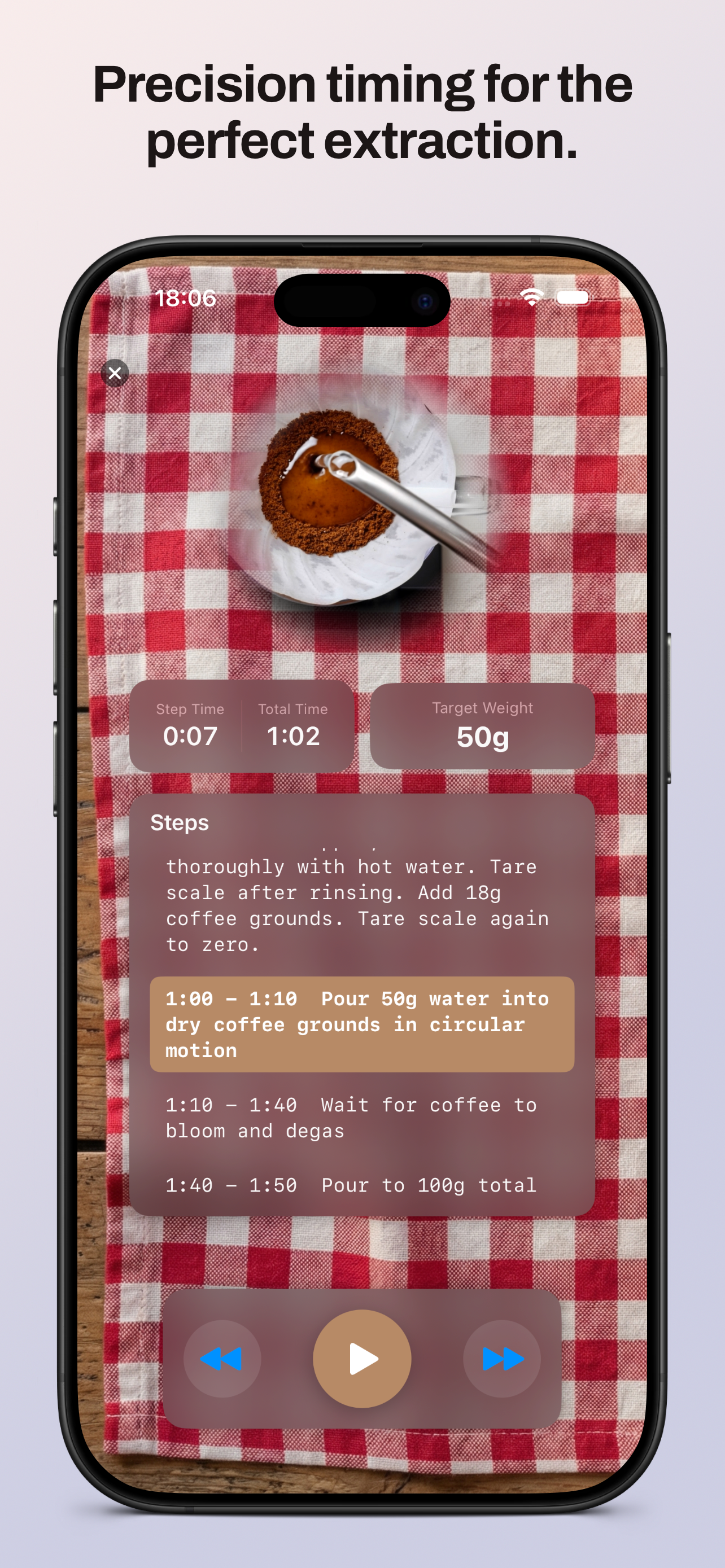
BrewGuide focuses on the part that is hardest to do mentally while brewing: staying on the right sequence without losing track of time. A step-by-step timer turns the recipe into a calm workflow instead of a memory test performed under pressure with a hot kettle in your hand.
That matters most during the main pours after the bloom. Consistent pour intervals are what keep the extraction even from start to finish. When the timing prompts are reliable, the brewer can pay attention to kettle angle and pour height instead of staring at a stopwatch while also trying to hold a consistent pour rate.
Over time, the consistency that a guided timer provides is what creates the feedback loop you need to actually improve. When every session follows the same sequence, the differences between cups become meaningful data rather than noise. You can change one variable intentionally and understand whether it made things better or worse.
Different drippers need different recipes
A Hario V60, a Kalita Wave, and a Chemex should not be brewed with the same recipe. Their internal geometries create different flow dynamics. The V60's single large hole and ribbed walls drain faster and require more active flow control during the pour. The Kalita Wave's three small holes slow the flow and make extraction more forgiving. The Chemex's thick filter slows things down further and produces a characteristically clean, bright cup.
That is why BrewGuide is organized around dripper-specific guidance rather than one generic timer. The app's goal is to teach repeatability within the specific constraints of the equipment you are actually using, not to provide a universal recipe that produces mediocre results across all of them.
If you are just starting with pour-over, the V60 is worth learning because its characteristics make technique errors more visible. When you can produce a consistent cup on a V60, you will find other drippers more forgiving by comparison.
Improvement comes from recorded feedback
The long-term goal is not to follow instructions forever. It is to build enough consistency that you can change one variable at a time and understand the result. That requires keeping records of what you actually did, not just what you intended to do.
Saved profiles in BrewGuide let you note the grind setting, dose, water temperature, and any observations from a session. When a cup tastes unusually good or unusually flat, you have something specific to compare against rather than trying to reconstruct what you did from memory two days later.
Better coffee usually comes from better iteration, not from finding a single perfect recipe once and reproducing it forever. The variables in play — bean freshness, seasonal humidity, grinder burr wear — shift gradually over time. The brewers who get the most out of pour-over are the ones who stay curious about what changed rather than assuming the recipe will always behave the same way.