
Productivity
From Saved Links to Usable Research Notes
A saved source becomes more useful when it carries a question, a reason, and a next step. Build a research library around retrieval rather than collection.
Collecting is only the first step
A folder full of links can look like progress before it has helped answer a single question. Saving is immediate and satisfying. Turning those sources into an explanation, a decision, or a piece of writing happens later, when the reason for keeping each page may already be less obvious.
The earlier Stashmark article explored why bookmarks need context. The next step is a practical one: deciding what context to keep and how to revisit it. A library should help you continue the work, rather than become a second project that demands its own elaborate maintenance routine.
Begin with one active question. It might concern a design choice, a subject for an essay, or an unfamiliar part of a codebase. A clear question gives each saved source a job and makes it easier to recognize when several pages are repeating the same contribution.
Save the reason alongside the address
At the moment of saving, write the sentence you would otherwise have to reconstruct later. Useful notes describe the connection: explains the limitation we encountered, gives a counterexample to the proposed approach, or includes the original dataset behind this chart. The note can be short and still be specific.
Consider an article about organizing a research library. A note that says useful article adds little to its title. A note that says compare its project folders with our topic folders tells your future self why the source belongs in the current investigation and what to do with it.
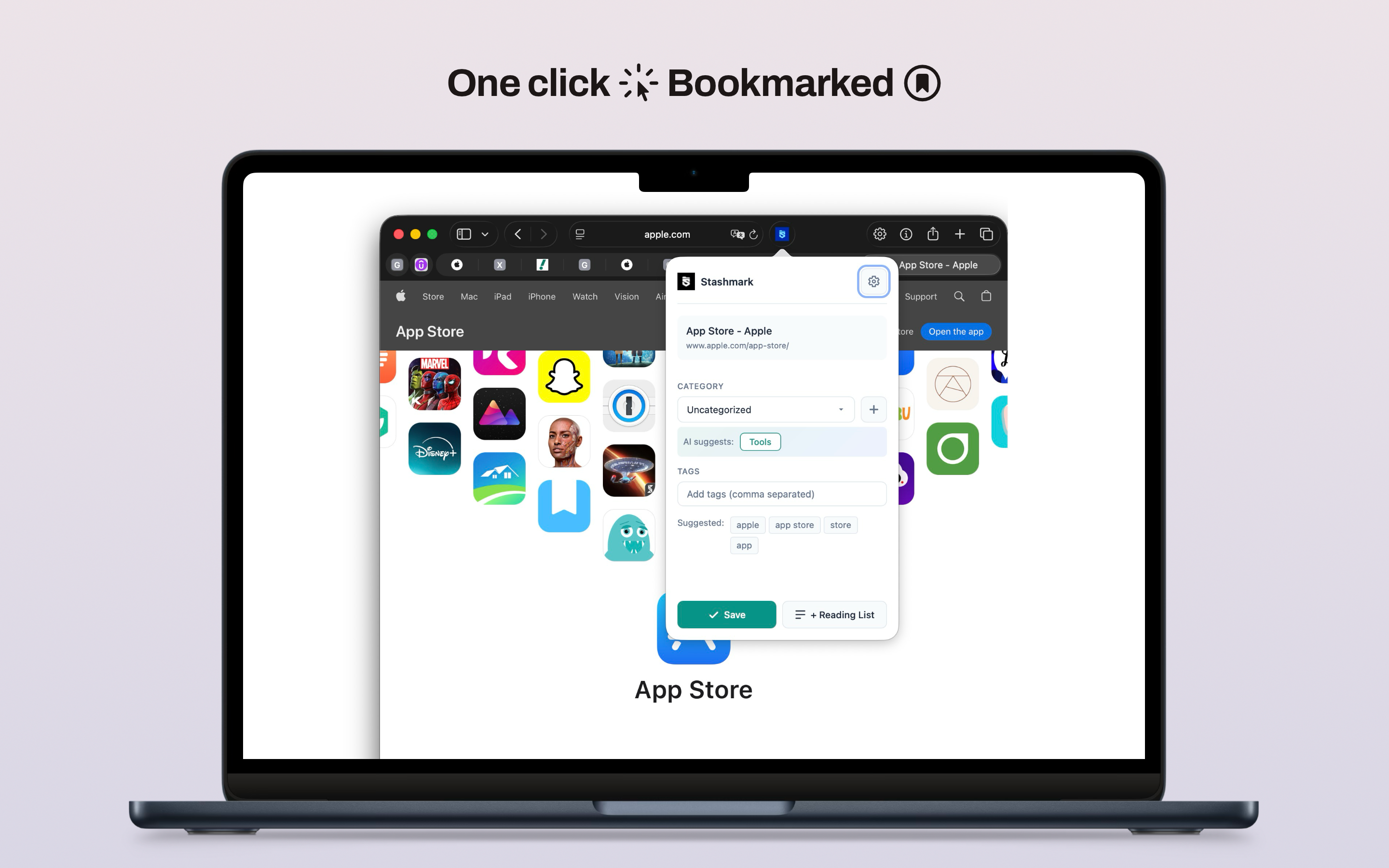
Stashmark's saving and organization workflow is useful here because it keeps the source close to the classification decision. Treat any suggested category as a starting point. The small piece of meaning you add yourself is often the part a title or an automatic label cannot supply.
Separate what a source says from what you infer
Research notes become harder to trust when quotations, paraphrases, and personal conclusions blur together. Even a private library benefits from a clear distinction. Label a copied passage as a quotation, keep the source address, and write your own interpretation in a separate sentence.
For example, a product page describing an export feature establishes that the feature is documented. It does not establish that every field survives a round trip through another tool. That second claim needs a test or a more specific source. Recording the gap makes the next research step visible.
You do not need a formal citation system for every casual bookmark. You do need enough provenance to find the original passage and reconsider your interpretation. When a source changes or another page contradicts it, that separation lets you revise the conclusion without losing track of the evidence.
Organize around retrieval questions
A category earns its place when it helps you find something again. Start with names that reflect the questions you actually ask: sources for the current essay, reference material for a project, or examples to revisit during a design review. A sophisticated hierarchy is useful only if you use it.
Stashmark supports nested categories, but nesting should solve a concrete retrieval problem. If a folder contains only a few links, another layer may create more navigation than clarity. If a growing topic has distinct branches you return to separately, a small amount of structure can make those branches easier to scan.
Try retrieving a source without remembering its title. Can you reach it through the project or question that made it useful? That exercise reveals weak category names more quickly than reorganizing the whole library according to a taxonomy that looks tidy but does not match your work.
Review a small set while the question is active
Choose a review point connected to the project, such as preparing an outline or revisiting a design decision. Read the notes for that question and decide what each source contributes. Some will support the current direction; others will reveal a missing explanation or a reason to change it.
Move beyond counting saved pages. Three sources that repeat the same assertion may add less than one source that explains the original evidence. Keep useful duplicates when they serve different purposes, but record those purposes so the distinction remains visible during the next review.
End the review with a concrete output. Write a paragraph, list the unresolved questions, or choose the next source to inspect. That small result connects the library to the work it exists to support. Otherwise a review can become another way to rearrange links without using them.
Check what portability preserves
Stashmark documents JSON and HTML export, providing ways to take a library outside the app. Those formats serve different purposes, and another tool may interpret them differently. The existence of an export button is a useful beginning; understanding the exported result makes it a practical safeguard.
Export a small sample and inspect it. Check whether the titles, URLs, categories, and notes you depend on are present in the format you chose. If you intend to move to another application, try the import with that sample before assuming the destination will preserve every part of your organization.
A link export also should not be confused with a saved copy of the underlying page. The original website can change even while your bookmark remains intact. For research that depends on a particular passage, keep enough source details and appropriate records to explain what you consulted and when.
Let the library earn its size
As a project finishes, decide what deserves to remain easy to find. Some sources will become durable references; others will be relevant only to the completed work. Preserving that distinction keeps a growing library from presenting every old task as if it were still active.
Avoid treating deletion or archiving as a judgment on whether saving was a mistake. A source can be useful for a week and then have served its purpose. The quality of the library is measured by how well it supports retrieval, not by how many entries remain in it.
The habit is straightforward: keep the address, preserve the reason, revisit the question, and produce something from the sources. Stashmark can support the storage and organization. Your brief notes supply the continuity that makes a saved page useful when the original browsing session is long gone.